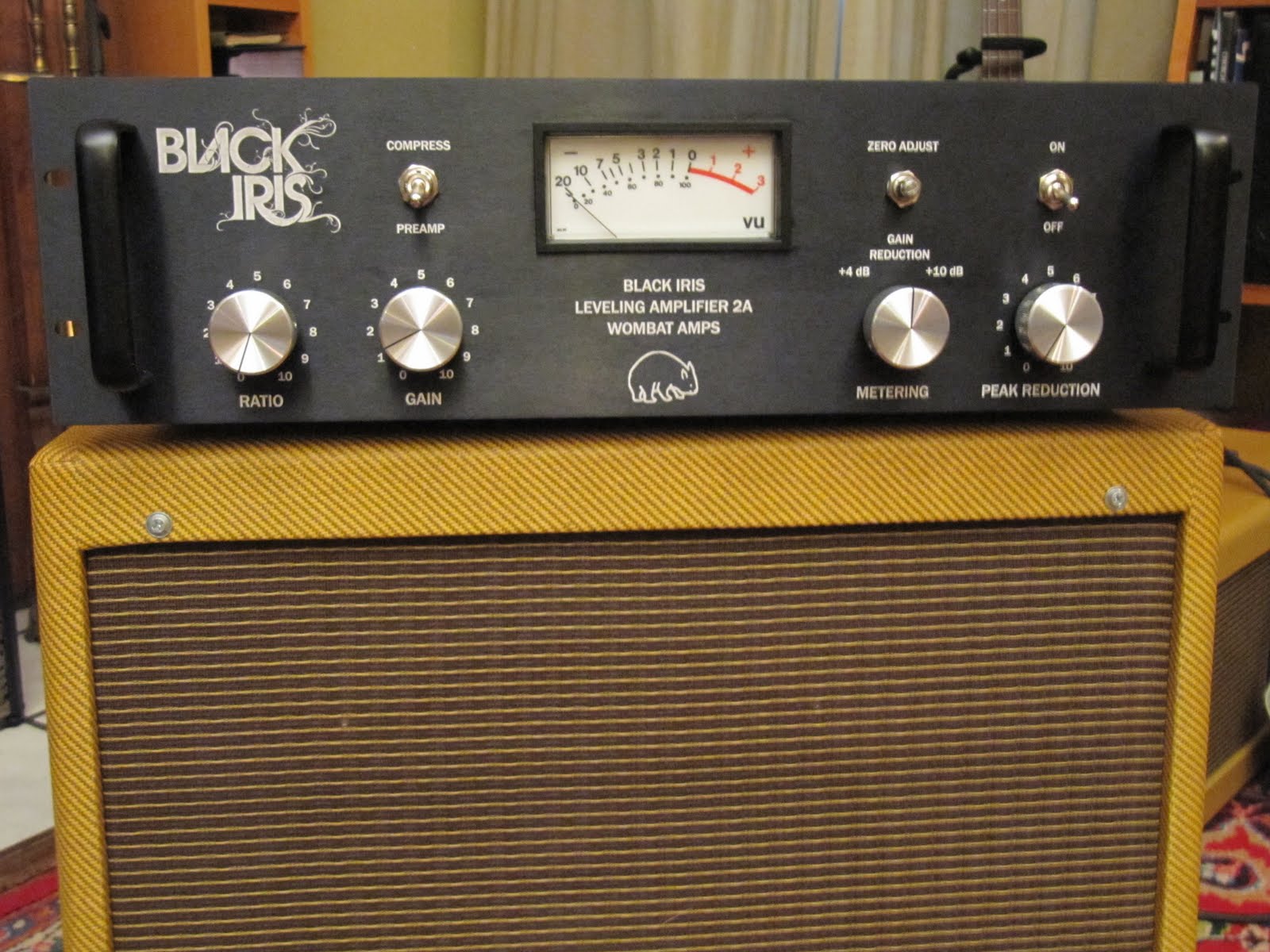
All right, it's done -- I think. Still need to trace the circuit and test this out, but here's what it looks like. I still need to update the layouts to reflect how things like the preamp/compress switch got wired, but I'll post those soon
Saturday, April 30, 2011
Thursday, April 28, 2011
LA-2A wiring almost finished!
The LA-2A wiring is almost finished. I just have a couple of things to tidy up, then I can trace the circuit to make sure I've built what I think I've built before firing it up for measurement and testing. I'll have plenty of gut-shots of the interior wiring and updated layouts posted here when I've got everything the way I want it, but in the meantime, I couldn't resist popping the top on, and taking some picture to show you what the finished unit looks like. Since the black anodized is slightly reflective, it's surprisingly hard to get decent photographs without glare or reflection, so excuse my crappy photography. The unit looks even better in person. What do you think?
Tuesday, April 26, 2011
LA-2A - cutting and fitting faceplate
Well, I've gotten a few days behind on the blog here. But I do have a few photographs to share. Basically, I've gotten through the faceplate cutting stage. Which frankly was very nervous making, but all turned out well in the end. When it comes right down to it, I really don't have an adequate workshop at my disposal, so virtually everything gets done with handheld tools. This included cutting the hole in the faceplate for the VU with a handheld Dremel tool.. I gotta say this step pretty much sucked, as you are constantly aware that just one slip of the hand will irretrievably mar the faceplate material. Fortunately, I made it through, and when all was said and done it was a perfect fit.
So here's the faceplate after cutting and drilling:
Mounting the Pots and VU meter:
First front panel test fit:
I've actually now got just almost everything wired up except for all the runs to the faceplate. We're getting pretty close, but I need to go back and take some pictures of the guts so you can see how I ended up doing things like the ground scheme. More soon as time allows. Aiming for initial fire-up this coming weekend.
So here's the faceplate after cutting and drilling:
Mounting the Pots and VU meter:
First front panel test fit:
I've actually now got just almost everything wired up except for all the runs to the faceplate. We're getting pretty close, but I need to go back and take some pictures of the guts so you can see how I ended up doing things like the ground scheme. More soon as time allows. Aiming for initial fire-up this coming weekend.
Thursday, April 21, 2011
LA-2A faceplate - test fitting the knobs
Exciting! I got the face plate back from the engraver this afternoon, and had a chance to see how it's going to look with the brushed aluminum 1.25" knobs (Mouser has the material incorrectly labeled as plastic online, but the paper catalog has it right) and the black anodized rack handles I'm using. Of course, I had to take a couple more snapshots:
Tuesday, April 19, 2011
LA-2A faceplate - some first snapshots
The faceplate is engraved, and it's looking good!
It hasn't arrived back here yet, but here's a few snapshots from the engraver that give a pretty good idea of how it turned out.
Full plate:
Black Iris logo:
Right hand side:
Now imagine this with some nice brushed aluminum knobs and a glowing backlit VU.
A big thank you to Mason!
It hasn't arrived back here yet, but here's a few snapshots from the engraver that give a pretty good idea of how it turned out.
Full plate:
Black Iris logo:
Right hand side:
Now imagine this with some nice brushed aluminum knobs and a glowing backlit VU.
A big thank you to Mason!
Saturday, April 16, 2011
LA-2A board 5
At last, the final board for the LA-2A is completed. This one has only five components - four diodes in a bridge rectifier for the 6.3V regulated DC, and a big-ass 10,000 uF / 50V reservoir cap for initial smoothing of the DC before it is sent to the voltage regulator. Note that in the original drawings I was showing a Fairchild integrated bridge rectifier rated 2A. However, I decided that 2A was an insufficient rating for this circuit. While the heaters themselves only draw 1.3A of current, the power factor of low voltage power supplies is inherently pretty poor. While average current should be under 2A, the RMS current will be above that. Probably the integrated part would have worked -- these integrated parts seemed to be rated for average current -- but why cut things close? The discrete parts I ended up using, and shown in the picture are 1N5408s -- these are 3A/1000V diodes, which should be plenty and then some. Besides, they look cool.
Drawing:
Finished board:
Note the criss-cross arrangement for the bridge, rather than the traditional diamond. It turns out to be quite convenient for many layouts.
Drawing:
Finished board:
Note the criss-cross arrangement for the bridge, rather than the traditional diamond. It turns out to be quite convenient for many layouts.
Friday, April 15, 2011
LA-2A main board and tube sockets
I only had a couple of hours to work on this today, so the main goal for today was just to mount the main circuit board and complete most of the wiring to the tube sockets. I'm pretty happy with the layout so far - the wiring runs to the sockets are all really nice and short, which helps a lot with noise reduction and makes for a nice stable amp that's not prone to oscillation or weirdness. I like how having the split boards allows the tube sockets to be approached from two directions. I'll have to remember this trick for future builds.
Wednesday, April 13, 2011
LA-2A back plate
I've managed to sneak in a few hours each night this week to work on the back plate of the LA-2A, and things are coming along nicely.
First off, here's the final drill plan. Actually, this version corrects a couple of minor issues with the version I used in order to improve spacing a bit.. for instance, the reservoir can capacitor has been moved a bit further from the top. But it's pretty close:
This is meant to be printed full sized and taped directly to the back panel. Actually, the back panel itself was first covered with a layer of clear packing tape to protect the paint during the drilling step. Then the paper was applied, and another layer of packing tape applied to ensure that nothing would move around or tear during the drilling process:
Pilot holes were drilled for everything with fine drill bit. Then, depending on the size of the opening, larger drill bits, a unibit, or hole saws were used. The small square opening for the IEC power filter was (carefully!) cut with a cut-off blade on a Dremel rotary tool.
Here's what the backplate exterior looked like when drilling was (nearly) finished and the IEC power filter being test fitted:
Here's the interior. Burrs have been removed with a Dremel grinding wheel. I've intentionally scuffed up the surface around most of the holes as well, since it is important that anything metal mounted in those holes ultimately have a secure electrical connection to the chassis (and therefore to safety ground). The anodized aluminum surface is not a good conductor. It's not particularly pretty, but it will all be hidden inside anyway:
Next up, we mount all the tube sockets, transformers, potentiometers, and other hardware:
Visible in the photo above is the vintage UTC-A24 output transformer I was able to find for the build.
Then I flipped it over, mounted the two circuit boards that attach to the backplate, and began wiring up what can be done at this point..mostly the heater wiring, a couple of runs to the tube sockets and some of the transformer connections:
You can see that I've gone ahead and attached the backplate to the bottom plate here for a test fitting. The bottom plate circuit boards and transforemer aren't actually mounted here yet, I was just assessing.... and it looks pretty good! You may have noticed that the anodization layer has been scrapped away on the edges of both the back and bottom plates... with a multi-section chassis like this it is important to ensure that the individual components are all electrically attached, again for the purpose of ensuring adequate grounding.
First off, here's the final drill plan. Actually, this version corrects a couple of minor issues with the version I used in order to improve spacing a bit.. for instance, the reservoir can capacitor has been moved a bit further from the top. But it's pretty close:
This is meant to be printed full sized and taped directly to the back panel. Actually, the back panel itself was first covered with a layer of clear packing tape to protect the paint during the drilling step. Then the paper was applied, and another layer of packing tape applied to ensure that nothing would move around or tear during the drilling process:
Pilot holes were drilled for everything with fine drill bit. Then, depending on the size of the opening, larger drill bits, a unibit, or hole saws were used. The small square opening for the IEC power filter was (carefully!) cut with a cut-off blade on a Dremel rotary tool.
Here's what the backplate exterior looked like when drilling was (nearly) finished and the IEC power filter being test fitted:
Here's the interior. Burrs have been removed with a Dremel grinding wheel. I've intentionally scuffed up the surface around most of the holes as well, since it is important that anything metal mounted in those holes ultimately have a secure electrical connection to the chassis (and therefore to safety ground). The anodized aluminum surface is not a good conductor. It's not particularly pretty, but it will all be hidden inside anyway:
Next up, we mount all the tube sockets, transformers, potentiometers, and other hardware:
Visible in the photo above is the vintage UTC-A24 output transformer I was able to find for the build.
Then I flipped it over, mounted the two circuit boards that attach to the backplate, and began wiring up what can be done at this point..mostly the heater wiring, a couple of runs to the tube sockets and some of the transformer connections:
You can see that I've gone ahead and attached the backplate to the bottom plate here for a test fitting. The bottom plate circuit boards and transforemer aren't actually mounted here yet, I was just assessing.... and it looks pretty good! You may have noticed that the anodization layer has been scrapped away on the edges of both the back and bottom plates... with a multi-section chassis like this it is important to ensure that the individual components are all electrically attached, again for the purpose of ensuring adequate grounding.
Saturday, April 9, 2011
LA-2A proposed face engraving plan
It's almost time to send the LA-2A faceplate off for laser engraving, so it's time to make some final decisions. Does the Wombat logo stay or go? How about the Leveling Amplifer text? The power switch is currently not labeled, but could be. I'm tending to think it doesn't need it. Any other last minute tweaks required?
Update - here's another pass at it. I forgot the switch that bypasses the compression and allows the unit to be used just as a mic preamp:
Wednesday, April 6, 2011
LA-2A boards 3 and 4
Chugging right along here -- have now fabbed boards 3 and 4 for the Black Iris LA-2A project.
Board 3 has the main rectifier diode and some circuitry for the regulated DC for the heaters. Note that I'm using for this a dual 8A 1200V "Stealth" diode in a TO-220 package... these are rectifiers with exceptionally fast and soft recovery characteristics. These are great for audio applications, as these characteristics should help nearly completely eliminate any diode switching noise or "hash". Unfortunately for you, you probably won't be able to find any. Fairchild has discontinued the dual common cathode version, and a few friends and I bought up several hundred -- pretty much all the remaining stock -- from a surplus place. Don't worry though, there's no reason you can't use a pair of the single diode versions to make a standard full wave rectifier, and these are still manufactured and available.
You are probably asking why second TO-220 package shown on the drawing isn't shown on the finished board? The other part in question is the 6.3V LDO voltage regulator for the DC heaters. As it will be dissipating significant heat, it needs to be heatsinked (bolted!) directly to the chassis. Therefore, it will actually lie underneath the board shown with the leads sticking up into the three turrets on the left hand side of the above picture. Getting it all mounted will no doubt be slightly fiddly, but some test fitting seems to indicate it shouldn't be too bad. The need to dissipate heat is also the reason that this part of the DC heater circuit is on a separate board from the board with the low voltage rectifier and reservoir cap... the surface under the other board is steel, which sucks as a heatsink. This board goes on the back panel, which is aluminum, and therefore an excellent heatsink. The DC regulator is in a fully insulated package, in case you are wondering, so no issues with bolting it directly on.
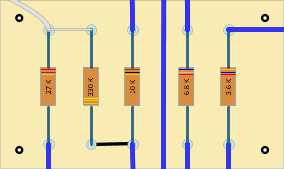
Board 4 is boring -- just a few resistors mostly for metering. You'll notice that the one on the far left is missing on the board. That's because it corresponds to R27 on the schematic, which is shown as having a value between 27K and 100K -- it needs to be selected to balance the metering, and the right value can only be chosen and soldered in once the circuit is being tested and a particular T4B is decided upon... although the compressor works just fine even if the metering is slightly wonky.
Only one board to go!! Then onto some proper drill plans.
Board 3 has the main rectifier diode and some circuitry for the regulated DC for the heaters. Note that I'm using for this a dual 8A 1200V "Stealth" diode in a TO-220 package... these are rectifiers with exceptionally fast and soft recovery characteristics. These are great for audio applications, as these characteristics should help nearly completely eliminate any diode switching noise or "hash". Unfortunately for you, you probably won't be able to find any. Fairchild has discontinued the dual common cathode version, and a few friends and I bought up several hundred -- pretty much all the remaining stock -- from a surplus place. Don't worry though, there's no reason you can't use a pair of the single diode versions to make a standard full wave rectifier, and these are still manufactured and available.
You are probably asking why second TO-220 package shown on the drawing isn't shown on the finished board? The other part in question is the 6.3V LDO voltage regulator for the DC heaters. As it will be dissipating significant heat, it needs to be heatsinked (bolted!) directly to the chassis. Therefore, it will actually lie underneath the board shown with the leads sticking up into the three turrets on the left hand side of the above picture. Getting it all mounted will no doubt be slightly fiddly, but some test fitting seems to indicate it shouldn't be too bad. The need to dissipate heat is also the reason that this part of the DC heater circuit is on a separate board from the board with the low voltage rectifier and reservoir cap... the surface under the other board is steel, which sucks as a heatsink. This board goes on the back panel, which is aluminum, and therefore an excellent heatsink. The DC regulator is in a fully insulated package, in case you are wondering, so no issues with bolting it directly on.
Board 4 is boring -- just a few resistors mostly for metering. You'll notice that the one on the far left is missing on the board. That's because it corresponds to R27 on the schematic, which is shown as having a value between 27K and 100K -- it needs to be selected to balance the metering, and the right value can only be chosen and soldered in once the circuit is being tested and a particular T4B is decided upon... although the compressor works just fine even if the metering is slightly wonky.
Only one board to go!! Then onto some proper drill plans.
Tuesday, April 5, 2011
LA-2A board 2
Got in another few hours after work today to work on another of the boards for the LA-2A. This one has the circuitry for the T4B, the negative feedback loop for V1, and the output coupling cap leading to the output transformer. Note a couple of deviations from the standard LA-2A here. First, the 10uF electrolytic coupling cap has been paralleled with a smaller Mallory film cap to help preserve good response in the high frequency range. Electrolytic caps by themselves can a have significant, and negative, impact on tone as their impedance begins to rise at a higher frequencies. This should take care of that. Second, I've added some small 1K grid stoppers here (and on the other board as well). Modern best practices demand grid stoppers for every valve! They are small enough that they will have no effect on the high frequency response, but should be sufficient to act as insurance against any weird inductive or capacitive coupling that might lead to oscillation at higher gain.
Finally, attentive readers might notice that the original 50-380pF varicap for C4 has been replaced with a fixed value silver mica cap. I'm starting with 330pF as a value that should avoid rolling off too much high end. This value will be tweaked to taste if necessary later.
Sunday, April 3, 2011
From drawing to board
I had a nice day getting started on the actual construction phase of the Black Iris LA-2A. Today, I tackled the main turret board, the largest of the five boards needed for this project. I thought I'd snap some pictures as I went along to show how I make my point-to-point wired turret boards.
First, we start with a picture of the board, we want to make. I start with a PNG image exported from the DIY layout creator software I use. I then import this into Canvas (or other) drawing program, and crop the image down to just the bit I want. I then scale the board to the actual size I'm going to fabricate, and print it out.
Next up, we cut some 1/8" G10 Garolite (a durable and non conductive fiberglass composite that is ideal for turret boards) to the desired size:
The main board here is 10.25" x 3.125". Not shown is where I actually tape my full size printout of the layout right onto the garolite. I then use this as a drill guide to drill the holes for the turrets. But you end up with something like this:
Next, it's a matter of staking the turrets in place. In my case, I prefer a part that is something more like a cross between a turret and an eyelet. They're probably actually some kind of rivet -- I got them from George Metropoulos at Metroamp. They're pretty easy to stake...just gently crimp the base with wire cutters, drive them home with a hammer, and they're there to stay. The resulting boards are easy to work with.
Once their mounted on my handy-dandy PanaVise stand, it's just a matter of populating the board with the discrete components. This is absolutely my favourite part of amp building... there's something very pleasing about taking each component from it's pouch, testing it, bending and trimming the leads just so, and soldering it in place. It's probably bad for me, but I confess I love the smell of the rosin in the solder. And this stage is really rewarding, because only a few hours later you have a finished board ready to be mounted in the chassis and wired in:
It's fun to compare the initial drawings with the final realization.
First, we start with a picture of the board, we want to make. I start with a PNG image exported from the DIY layout creator software I use. I then import this into Canvas (or other) drawing program, and crop the image down to just the bit I want. I then scale the board to the actual size I'm going to fabricate, and print it out.
Next up, we cut some 1/8" G10 Garolite (a durable and non conductive fiberglass composite that is ideal for turret boards) to the desired size:
The main board here is 10.25" x 3.125". Not shown is where I actually tape my full size printout of the layout right onto the garolite. I then use this as a drill guide to drill the holes for the turrets. But you end up with something like this:
Next, it's a matter of staking the turrets in place. In my case, I prefer a part that is something more like a cross between a turret and an eyelet. They're probably actually some kind of rivet -- I got them from George Metropoulos at Metroamp. They're pretty easy to stake...just gently crimp the base with wire cutters, drive them home with a hammer, and they're there to stay. The resulting boards are easy to work with.
Once their mounted on my handy-dandy PanaVise stand, it's just a matter of populating the board with the discrete components. This is absolutely my favourite part of amp building... there's something very pleasing about taking each component from it's pouch, testing it, bending and trimming the leads just so, and soldering it in place. It's probably bad for me, but I confess I love the smell of the rosin in the solder. And this stage is really rewarding, because only a few hours later you have a finished board ready to be mounted in the chassis and wired in:
It's fun to compare the initial drawings with the final realization.
Subscribe to:
Posts (Atom)