Showing posts with label EQP-1A. Show all posts

Wednesday, November 14, 2012

Black Iris Toyota spot

Cam DiNunzio and the folks over at Black Iris have been busy lately!  If you've been following this blog, you know that Black Iris commissioned both the EQP-1A tube equalizer and the LA-2A optical compressor described at length in earlier posts here.  Cam has told me that these have been used in the recording of the music for quite a few television commercials that you may have seen over the last year or so. But my favourite is a jingle that that Black Iris did recently for the Saatchi & Saatchi Agency for their Toyota Prius "Hum" ads.  Cam used both the Wombat Amps EQP-1A and the LA-2A for tracking the acoustic guitar and the vocals, and evidently the agency "continuously commended the 'warm' and 'natural' sound of the recording".  Cool!  

This 30 second spot came out awhile ago, back in September I think:


However, I just became aware of this newer 60 second spot, which is what prompted me to post this today:


Wednesday, December 7, 2011

EQP-1A delivered

After double checking the circuit using the invaluable old highlighter technique, and putting in a couple of ground runs I had missed, I got the EQP-1A fired up without difficult.

The first thing I noticed was that the voltages from the Hammond 270CAX power transformer I used were running rather low - almost 50V below the schematic.  But Hammond transformers now have optional taps for the primary windings to reflect the fact that wall power in North America has crept up over the years from 110VAC to now typically closer to 120VAC.   Since, I had originally wired it up with the 125VAC (black & white) primary combo, I just rewired it with the 117VAC (grey & white) combo to bump it up a bit.  This got me a bit more than 25V back.. So the final B+ voltage is still 22V or so below the schematic, but it's not really enough to be concerned about --- approximately 7% or so below nominal, and this with my line voltage in the house running a bit low.. So it's basically within 10% and should be fine.  Everything else checked out voltage wise.  Popped in a nice NIB NOS GE grey plate 12AU7, and one of the new production Tung-Sol reissue 12AX7s, and we were ready for action.  Everything checked out with tubes in as well. 

As I pointed out earlier, one small question mark was whether there would be an issue with running the 5VAC and 6.3VAC windings of the PT in series in order to feed the DC regulator for the heaters.  The numbers suggest that the 5VAC winding will have its VA rating pushed just a bit.  But on the other hand, the remainder of the PT is completely loafing, as current draw for the remainder of the whole circuit other than the heaters is less than 20mA.  And indeed, even with many hours of continuous operation,  the PT showed absolutely no signs of overheating or any kind of stress.  Hammonds are also well known for their conservative ratings to begin with.  So no worries... rock solid 6.3VDC coming out of the regulator to feed the tube heaters?  Check.

Alrighty then, the next issue was confirming correct operation.  I used some cheapo XLR to RCA adaptors to interface the equalizer with my M-audio Audiophile 24/96 soundcard.   I've had this thing sitting in a drawer for a couple of years, since it didn't play nicely with a motherboard I had in an earlier computer.   But I was recently *amazed* to discover that this sound card is still being sold, and the drivers are still supported, up to 64 bit Windows 7.  The PCB on my sound card is stamped with a date in the year 2000 - practically prehistoric in computer terms! But anyway, it's still a very capable little card, which I guess is why it's still in production. It works great on my current machine.

Anyway, long story short, I was quickly able to confirm the EQ seemed basically to be working as predicted just by playing music through it as I messed with the knobs... but that's not enough! I wanted to make sure that the entire frequency response looked right - so I needed some help on the software front.  Fortunately, a bit of poking around led me to the excellent HolmImpulse freeware from Holm Acoustics..  this software is actually intended for characterizing the frequency and impulse response of speaker setups. But it's also ideal for this application.  Using this software, I was able to virtually replicate, with only extremely minor variation, the frequency responses shown in the original EQP-1A users manual.  Awesome!  In some ways it never ceases to cause wonderment that it's possible to come along fifty years later and recreate something and have it behave pretty much exactly as the engineers and designers had intended.

The only minor red flag was that the noise floor of the unit didn't seem to be so great... about -70dB or so seemed to be the best it could do.  However, I quickly remembered that for testing with my sound card, I was running the unit in an unbalanced configuration - and my workshop/mancave is a total swamp for EMI.  I had every reason to believe it would be much better in actual balanced use in the studio....

It didn't take long to find out.  I delivered the EQ to Cam DiNunzio at the Black Iris studio on Tuesday, and we quickly put it through its paces.   Bottom line?   The noise floor in balanced operation in the studio was somewhere below -90dB.  I don't know for sure where, as that's as low as his protools metering system would go. Anyway, as I left, Cam was already gearing up to put the EQP-1A to work on a TV spot he's working on.  Here's a few pics of the finished unit and the happy new owner:
Getting it set up. Note the Wombat Amps LA-2A in the right-hand stack


Cam DiNunzio of Black Iris gives the EQP-1A a whirl
Welcome to the family!

It was fun catching up with Cam.  Next blog post, maybe I'll be able to post some links to TV spots that have the used the LA-2A... there's already a fair number that have either aired or are in the pipeline.   Keep your eyes and ears open right now for the Sears' Christmas commercial that airing now... it made extensive use of the Wombat Amps LA-2A.  Airing soon are spots for Subaru and Electronic Arts.

Saturday, December 3, 2011

Black Iris EQP-1A complete!

Since it's just me and the dogs this weekend, I've had some time to watch some bad movies and wrap up the hand-built EQP-1A inspired build I've been working on for Cam DiNunzio of Black Iris Music and Heks Orkest. I haven't had a chance to fire it up yet  -- I'll wait 'till I'm fresh and fully alert before I confirm the circuit and give it the juice for the first time and put it through its paces -- but in the meantime I thought I'd post some pictures of the final product, including some obligatory gutshots.  I'm really pleased with the way the layout all came together! 


If you've been following the blog, you'll notice it's a companion piece to the LA-2A inspired build I did for Cam previously.  Thanks again to my friend and Gothik Amps cohort from Alexandria, Virginia (you know who you are!) for assistance with the laser engraving of the front panel. I love the way the natural aluminum knobs contrast with black anodized aluminum of the chassis!


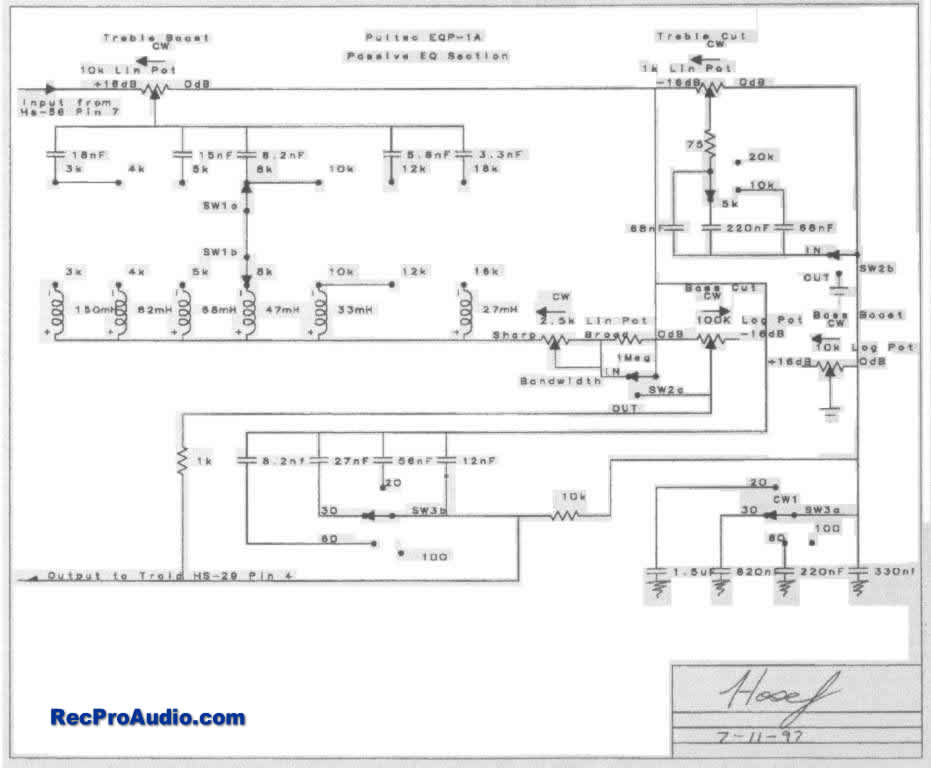
If you're of the generation that's only used to using a parametric EQ, the EQP-1A is a bit different.  Check out the user manual of the original.  It basically has four low frequency (20, 30, 60, and 100 Hz) and seven high frequency bands (3, 4, 5, 8, 10, 12, 16 kHz) that can be boosted.  In addition, the same four low frequency bands can be attenuated, along with three high frequency bands (5, 10, 20 kHz).   In addition, the width of the boost-able high frequency bands can be adjusted with the bandwidth control. Finally, there's an in/out switch that optionally bypasses all of the filters.  It turns out to be a quite amazingly flexible arrangement.


The overall layout uses three boards... The large one is for the main amp section, the long one near the front is primarily for the filter section, and the small one at the back is the DC regulator for the tube filaments.


Main board close up.    Tubes are (L-R) 12AX7, 12AU7, and a 6X4. The only shielded run in the build is the long white wire running from the input to the control panel. It looks like it's close to the 12AU7, but in fact it's just an illusion of the photograph -- it's inches away.


Most of the wiring work went into the filter section.  Getting all the wires to and from the seven-position rotary switch was, frankly, something of a pain in the ass.

Another couple of views...


The flash on this one gives you a better idea of what the silver on black panel looks like in real life!  Too bad I can never get rid of the glare.

Thursday, November 24, 2011

Thanksgiving update on the EQP-1A project

Now that the Grail amp has made its way to Switzerland, it's time to tidy up a couple of loose-thread projects.  First up is the final completion of the EQP-1A tube equalizer project,  intended as a companion piece to the Wombat Amps version of the LA-2A compressor I constructed for Black Iris Music. 

The main boards for this one have been complete for awhile, as has been the laser engraved front panel.  So the main job has been getting all the hardware mounted, and beginning the process of harnessing everything together.   Like the LA-2A, this project will also feature DC filament heaters, which, in conjunction with metal film resistors and a modern layout & ground scheme, will ensure virtually noiseless operation - or at least as noiseless as is achievable with tubes. 

Yesterday I had a chance to put together a DC heater circuit, based on the NJM2396F63 low-dropout regulator.  It's an interesting part, because it is designed to provide 6.3VDC -- and there's only one reason why anyone would want that oddball voltage... it's the standard for tube filaments. I'm not aware of any other application that require this, so I'm surprised there's still enough of a market niche to make these worthwhile to produce. 

Anyway, here's where things stand:

 
 Completed back panel 

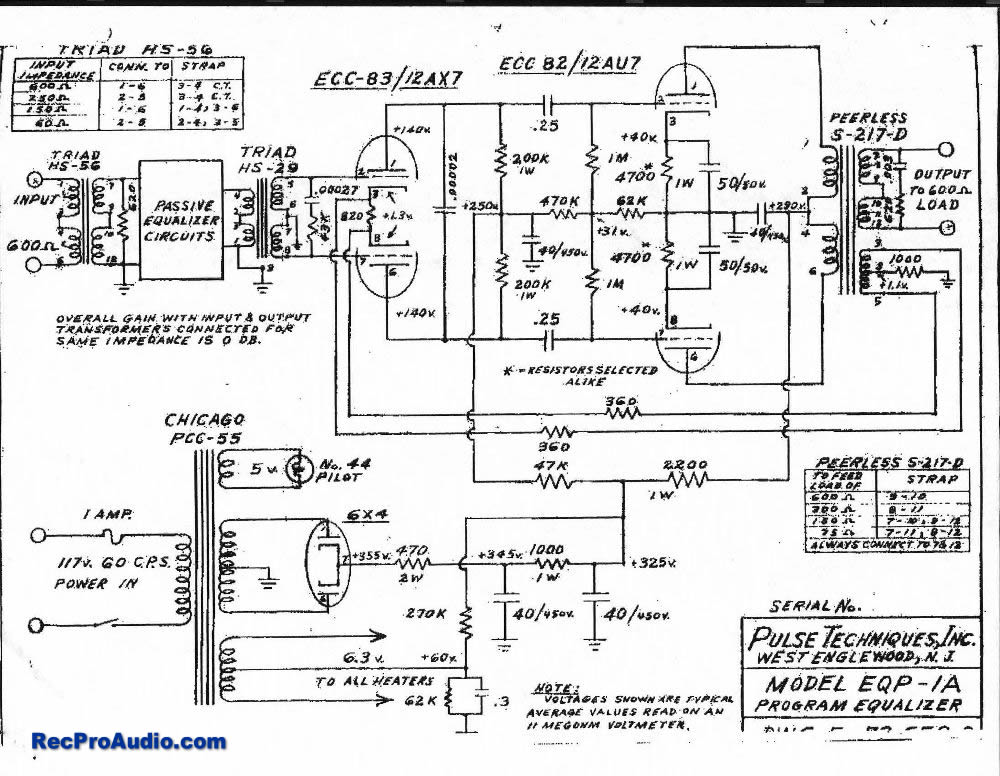
Note that the power transformer is mounted internally, as are the tubes.  Visible are the Sowter UK input and output transformers.  The input transformer is a 3603e 600:600 ohm isolating transformer.  The output transformer, the 9530e, is Sowter's version of the literally impossible-to-find Peerless S-217-D found in the original.  It's a highly unusual transformer, as it includes an odd centre-tapped tertiary winding that is used to provide about 4% NFB to the input valve, as is visible in this schematic.


Back Panel insides

Here's a view of the back of the inside of the back panel.  I'm using the Hammond 270CAX as the power transformer.  The current plan is to use the 5V and 6.3V windings of this transformer in series in order to feed the DC regulator.  Note that the 6X4 rectifier tube is slightly unusual in that it employs 6.3VDC for its filament, rather than the common 5V -- all three tubes together will require 1.2A at 6.3VDC.  By my calculations (and accounting for power factor) this will push the VA rating of the 5V winding a bit.  However, the rest of the transformer will be pretty much loafing - the current demand for the high voltage part is very small indeed.  I therefore don't anticipate any difficulties, but in the unlikely circumstance that the transformer does get a bit too warm, I have a couple of fallback strategies... I left enough room internally for a separate filament transformer, as I used in the LA-2A.  Alternatively, it turns out that there is a 12.6V version of the 6X4 rectifier (called, you guessed it, the 12X4) -- just changing to a 12.6V heater instead of the original 6.3V would halve the current demand, and would be easier on the LDO regulator as well.


Mounted main boards

Finally, I got the main boards mounted in place, and the majority of the front panel controls wired up.  I made one small modification the larger main board... you'll notice a silver can visible on the right hand side.  This is the Sowter 9330e interstage transformer, which replaces the original Triad HS-29.  There was just enough room to mount it here, and the position turns out to work well with my layout.  Finally, the silver can (actually mu-metal for best noise rejection) on the filter board with all of the orange-drop capacitors is the Sowter 9325e inductor required for the EQ.  This build sure required sourcing a bunch of very specific oddball parts, so I'm very grateful that Sowter is producing these extremely high quality reproductions -- otherwise a faithful build of the EQP-1A would be next to impossible.


It won't be long now! Look for a wrap-up on this one soon!


Sunday, June 26, 2011

EQP-1A Faceplate

Here's a quick preview of the EQP-1A faceplate.  Not shown are the switches and the power indication lamp.


Friday, June 24, 2011

Coming soon - the Wombat Amps program equalizer 1A

It's on hold temporarily while I work on the Grail amp commission, but I've also been working on my next studio gear project --  a clone of the revered Pultec EQP-1A tube EQ unit. It's basically a nice passive filter circuit with a balanced tube recovery section.

As is usual, I've gone my own way with layout and ground scheme for this rack-mountable unit.   As I did for the Black Iris LA-2A project, I'll be converting the heaters to DC for exceptional noise performance.

In this case, I've made the decision to mount the three tubes internally.

I'll post layout images later, but in the meantime, here's some pictures of the already-wired main board and filter board.  Notice that for the filter board, I've chosen to mount the Sowter inductor directly to the board.   I'll also be using Sowter UK iron for the input, interstage, and output transformers.

Filter Board and Inductor:


Main board, front:


Main board, backside: